
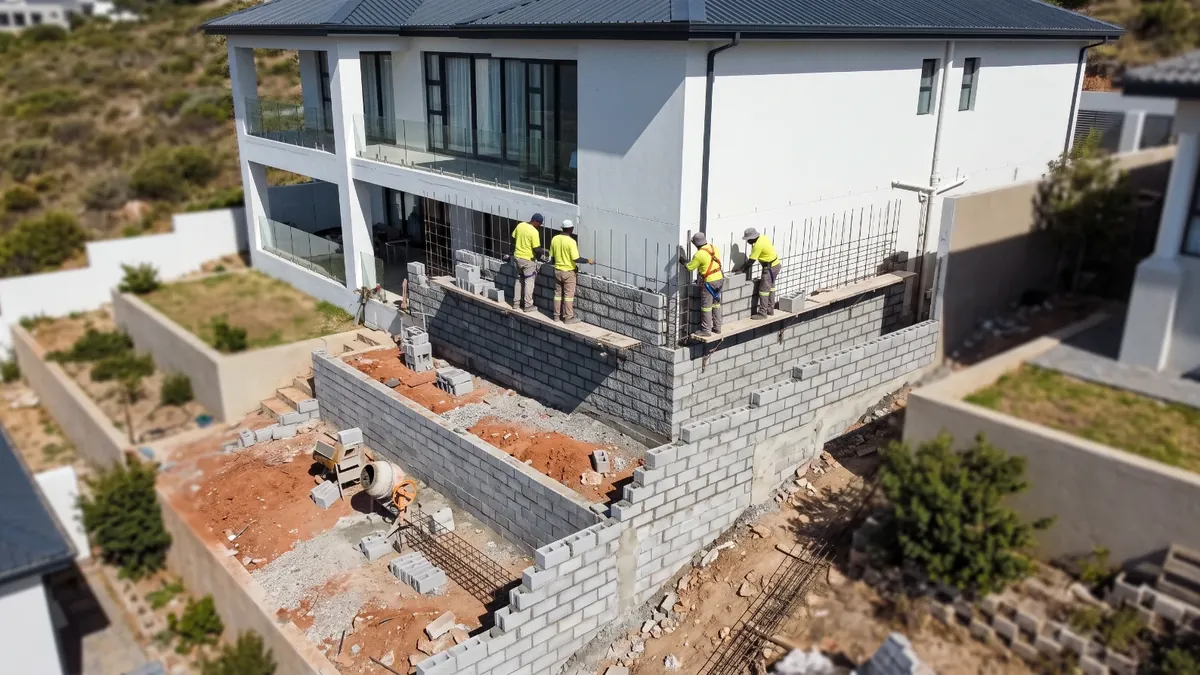
Boundary Walls South Africa are the perimeter walls that close a property line, built in brickwork and plaster, in precast concrete panels, or topped with palisade or clearvu where someone wants to see through. They are priced per metre run rather than per square metre, so the length of the line and the height decide the total. Say how long the boundary is and what the ground does along it, and get priced quotations to compare.
Super easy & fast
- Know what a metre of boundary wall should cost, so you never pay too much.
- Send the same boundary line to several walling contractors, and quotes come back fast.
- From LEADERR APPROVED providers, vetted and backed by many verified 5-star reviews. Peace of mind that the foundation and the piers suit the height you are building.
Say how long the boundary is and how high you want it, and get walling quotes.
Get the Best QuoteBoundary Walls Prices
Ballpark figures so you can check a quotation.
| Item | Ballpark price |
|---|---|
| Precast concrete panel wall, per metre run, 1.8m high | R550 - R1,100 |
| Plastered brick wall, per metre run, 1.8m high | R1,200 - R2,400 |
| Foundation trench and concrete strip, per metre run | R280 - R750 |
| Plaster and paint, per square metre of face | R160 - R420 |
| Pedestrian gate opening, posts and gate | R3,500 - R11,000 |
| Driveway gate opening, posts and lintel | R4,500 - R16,000 |
| Demolition of an old wall, per metre run | R180 - R550 |
| Typical 30 metre precast boundary, built and capped | R18,000 - R34,000 |
Prices JUST UPDATED. Ballpark figures, rounded, excluding VAT. They reflect typical South African retaining wall, repair and slope rates. They are not our prices or quotations, and no provider is bound by them. A retaining wall is quoted on the SQUARE METRES OF ITS OWN FACE, height times length, not on the size of the stand, so confirm what each quotation includes, such as the wall area it is priced on, the excavation, the drainage behind the wall and who removes the spoil.
What a Boundary Wall Quote Covers
- Setting out the line. Agreed against the title diagram or a surveyor's pegs, not against the old fence.
- The foundation. A trench and a concrete strip. Depth is set by the height and the ground.
- The wall and its piers. Panels or brickwork between piers at set centres, priced per metre run.
- Capping and finish. Coping, plaster and paint, or a bagged finish on a face that will be seen.
- Openings. Gate posts, a pedestrian gate and a motor base if one is going in later.
Where Quotes Differ Most
- Which wall is priced. Precast panels and plastered brickwork are two different totals per metre.
- Height. Every course adds brick, plaster and foundation, and may bring plans into it.
- Ground along the line. Rock, fill or a falling slope means stepping the wall and deepening the trench.
- Whether a top is included. Palisade, clearvu and electric fencing are separate trades and separate lines.
- Demolition of the old wall. Taking one down and carting it away is often left out of a comparison.
A Boundary Wall Is Not a Retaining Wall
- It is built to stand, not to hold. A perimeter wall carries its own weight and the wind, and nothing else.
- Soil against one side pushes it over. Ground loads a wall sideways and a strip footing cannot resist that.
- A bank needs its own structure. The retaining wall is built clear of the boundary, with its own base and drainage.
- Filling up to a wall is the usual cause. A level platform made by tipping soil against a boundary is how both walls fail.
- Say if the ground is not level. A contractor pricing a flat line will have allowed for none of it.
Get a price for your own boundary rather than a range.
Get the Best QuoteWhat Affects the Price
- How long the boundary is. The rate per metre eases as the run gets longer, because setting out is spread.
- How high you build. Height drives the foundation, the pier spacing and sometimes a council plan.
- Which system you choose. Precast panels are the cheapest per metre, plastered brick the most finished.
- What the ground does. A falling line has to be stepped, and each step adds foundation.
- Rock or fill in the trench. Breaking rock or founding through soft fill both deepen the excavation.
- Access along the line. A wall behind a house is barrowed, which is slower than one off the street.
- Whether security tops are added. Electric fencing and spikes are priced per metre on top of the wall.
What to Include in Your Request
- The address. Suburb and town, so a contractor knows whether they work there.
- The length and height. Metres along the line and how high you want to finish.
- Whether the ground is level. And if not, how much it falls from one end to the other.
- What is there now. An old wall, a fence, hedging or nothing, and whether it must come out.
- Openings. Where the driveway and pedestrian gates go, and how wide.
- Whether soil will be held. If a bank touches the line, say so. It changes the structure entirely.
Before You Appoint a Boundary Wall Contractor
- Check the line with your neighbour. A wall built on the wrong side of a peg is an expensive conversation later.
- Ask what height is allowed. Municipalities set their own limits and plan thresholds, so check with yours.
- Ask what the foundation is. Depth, width and strength in writing, because none of it is visible afterwards.
- Ask about pier spacing. Long unsupported panels are what crack and lean first.
- Ask whether the wall will hold soil. If the answer is yes, you are buying a retaining wall rather than this.
- Ask what is excluded. Demolition, rubble removal, gate motors and painting are the usual ones.
Boundary Walls FAQs
How much does a boundary wall cost per metre in South Africa?
Roughly R550 to R1,100 a metre run for a 1.8m precast concrete panel wall, and R1,200 to R2,400 a metre for plastered brickwork at the same height. A 30 metre precast boundary, built and capped, commonly lands between R18,000 and R34,000. Ground conditions and gate openings move it most.
Do I need council approval for a boundary wall?
Often above about 1.8m, and sometimes lower on a street boundary or a corner stand. The height limit and the plan threshold are set by your own municipality rather than nationally, so check with yours before the trench is dug.
Who pays for a shared boundary wall?
That is between the two owners and is best settled in writing before building. Many are split, some are paid by whoever wants the wall, and in an estate the scheme rules often decide it. Agree who maintains it as well, not only who builds it.
Can a boundary wall hold back soil?
Not as built. A perimeter wall is designed for its own weight and the wind, on a narrow strip footing with nothing resisting a sideways push. Ground piled against one face is the most common reason a boundary wall leans and then falls. A bank needs a retaining structure of its own, clear of the boundary.
How long does a boundary wall take to build?
A 30 metre precast wall is often three to five days on site once the trench is in. The same length in plastered brickwork is commonly two to three weeks, because the brickwork, the plaster and the paint each need their own time.
Perimeter walling is one of the services most contractors on Retaining Walls South Africa cover alongside retaining work, so the two are worth quoting together.
Related Services
Get the Best Quote, Fast
Client Reviews
Powered by leaderr