
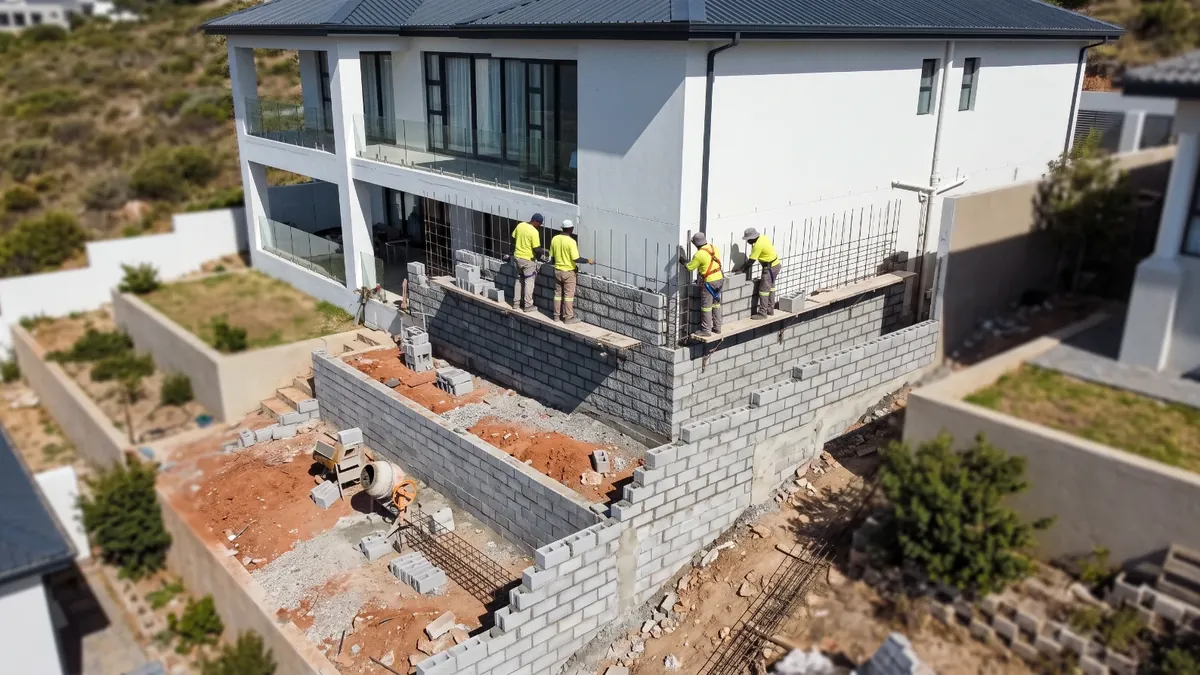
Retaining Wall Drainage South Africa is what keeps the ground behind a wall from turning into water pressure the wall was never designed to hold. Saturated soil pushes far harder than dry soil, which is why most failed walls were drained badly rather than built badly. Say whether water is seeping through or standing behind it, and compare priced quotations.
Super easy & fast
- Know what a metre of drainage should cost, so you never pay too much.
- Send the same wall details to several contractors, and quotes come back fast.
- From LEADERR APPROVED providers, vetted and backed by many verified 5-star reviews. Peace of mind that the stone is wrapped and the pipe has a real outlet.
Say whether water is seeping through or standing behind the wall, and get quotes.
Get the Best QuoteRetaining Wall Drainage Prices
Ballpark figures so you can check a quotation.
| Item | Ballpark price |
|---|---|
| Drainage built into a new wall, per metre run | R250 - R700 |
| Clean stone backfill and geofabric, per square metre | R180 - R520 |
| Perforated subsoil pipe, laid, per metre run | R120 - R380 |
| Weep holes through a solid face, each | R180 - R550 |
| Cut-off drain above the wall, per metre run | R280 - R850 |
| Piped outlet to a stormwater point, per metre run | R220 - R650 |
| Retrofit drainage into an existing wall, per metre run | R950 - R2,800 |
| Opening and relaying a wall face, per square metre | R1,200 - R3,500 |
Prices JUST UPDATED. Ballpark figures, rounded, excluding VAT. They reflect typical South African retaining wall, repair and slope rates. They are not our prices or quotations, and no provider is bound by them. A retaining wall is quoted on the SQUARE METRES OF ITS OWN FACE, height times length, not on the size of the stand, so confirm what each quotation includes, such as the wall area it is priced on, the excavation, the drainage behind the wall and who removes the spoil.
What Proper Drainage Is
- Clean single sized stone. Directly behind the wall, with no sand or fines in it to clog the voids.
- Geofabric around the stone. So soil cannot wash in and blind the drainage layer over time.
- A perforated subsoil pipe. At the base of the stone, laid to a fall rather than flat.
- A real outlet. Somewhere the pipe discharges where water can run away and be seen running.
- Weep holes through a solid face. On concrete and mortared walls, working with the pipe and not instead of it.
Where Quotes Differ Most
- Whether the stone is clean. Crusher run is cheaper than single sized stone and does not drain.
- Whether geofabric is included. It is a small cost and it is the reason the layer still works in ten years.
- Whether the pipe is piped out. A pipe that stops in the ground is not an outlet.
- Surface water above the wall. A cut-off drain or shaped ground stops water reaching the backfill at all.
- Retrofit or new build. Opening up a finished wall is far more work than drainage built in from the start.
Retrofitting a Wall That Is Already Pushing
- Find out where the water comes from. Surface runoff, a leaking pipe or a spring behind the bank.
- Take the surface water away first. Often the cheapest fix, and sometimes the whole fix.
- Open the wall in sections. Not all at once, so the bank is never unsupported along its length.
- Put the stone, fabric and pipe in properly. Then relay the face rather than propping it.
- Check it in the next heavy rain. Drainage is only proven when you watch water leave the outlet.
Get a price for your own wall rather than a range.
Get the Best QuoteWhat Affects the Price
- New build or retrofit. Built in with the wall it is cheap. Cut in afterwards it is several times more.
- Where the outlet can go. A long run to a stormwater point is metres of trench and pipe.
- How much stone the wall needs. A tall wall carries a deeper drainage layer behind it.
- Whether surface water has to be cut off. A drain above the wall is a separate line with its own trench.
- Access. Stone barrowed in costs real money on a stand a truck cannot reach.
- What is behind the wall already. Paving, lawn or planting that has to be lifted and put back.
- Whether the face must be opened. Relaying blocks or breaking out concrete is the bulk of a retrofit.
What to Include in Your Request
- The address. Suburb and town, so a contractor knows whether they work there.
- The wall height and length. Measured at the highest point and end to end, even roughly.
- What the wall is made of. Blocks, concrete, brick, stone or sleepers.
- What you are seeing. Seeping through the face, standing water above it, or a wall starting to lean.
- What is above the wall. Lawn, paving, a driveway or a downpipe discharging near it.
- Where water could go. A stormwater kerb inlet, a channel or a lower part of the garden.
Before You Appoint a Drainage Contractor
- Ask what stone they are using. Clean single sized stone, not crusher run, and it should say so on the quote.
- Ask whether geofabric is in the price. Without it the layer silts up and stops draining within a few years.
- Ask where the pipe discharges. Point at it on site. If nobody can, there is no outlet.
- Ask about the fall on the pipe. A flat subsoil pipe holds water instead of carrying it away.
- Ask about surface water. Where the rain lands above the wall often matters more than the drain behind it.
- Ask how they will stage a retrofit. Opening a whole wall at once is how a bulging wall becomes a collapsed one.
Retaining Wall Drainage FAQs
Why does a retaining wall need drainage?
Because saturated soil pushes much harder than dry soil. Walls are designed for the push of drained ground, so water trapped behind one is a load it was never meant to carry. Most walls that lean, bulge or fail were drained badly rather than built badly.
What stone goes behind a retaining wall?
Clean single sized stone, commonly 19mm, with no sand or fines in it. Crusher run looks similar, costs less and does not drain, because the fines fill the voids. The stone is wrapped in geofabric so surrounding soil cannot wash in and blind it.
Are weep holes enough on their own?
No. Weep holes let water out through a solid face, but something has to collect it and bring it to them. That is the stone layer and the subsoil pipe behind the wall. Weep holes with no drainage layer behind them usually end up blocked and the wall takes full pressure.
Can drainage be added to a wall that is already leaning?
Yes, and it is the right first move. The wall is opened in sections so the bank is never unsupported along its length, the stone, fabric and pipe go in properly, and the face is relaid. Expect roughly R950 to R2,800 a metre run, more if the face has to be broken out.
Where should the drain discharge?
Somewhere water can run away and be seen running, such as a stormwater inlet, a channel or a lower part of the garden well clear of the wall. A pipe that ends in the ground behind the wall is not an outlet and the drainage will not work.
Drainage is the line most often missing from a cheap quote, and every contractor on Retaining Walls South Africa should be able to tell you exactly what goes behind the wall.
Related Services
Get the Best Quote, Fast
Client Reviews
Powered by leaderr