
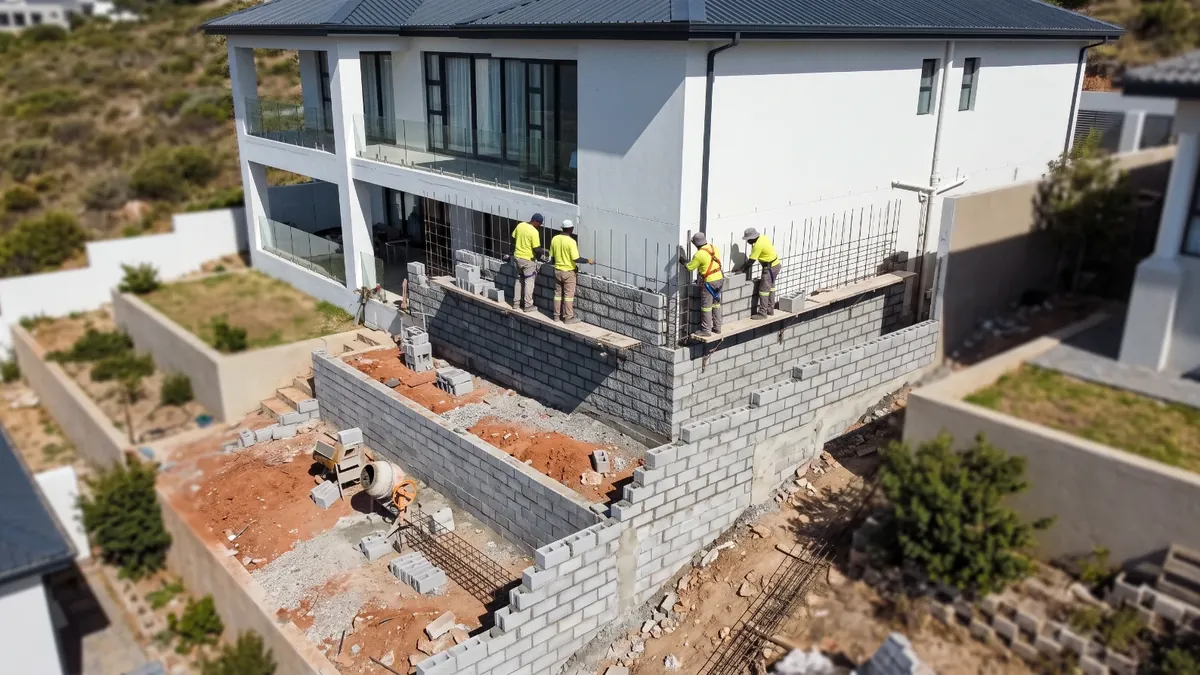
Underpinning South Africa is the work of putting new support under a foundation that is already built, by excavating short sections beneath it in sequence and casting them back solid. It is bought when the ground beside or below a footing changes, or when a structure has started to move. Say what the building is doing and what changed nearby, and compare priced quotations.
Super easy & fast
- Know what a pin should cost, so you never pay too much.
- Send the same crack photographs to several specialists, and quotes come back fast.
- From LEADERR APPROVED providers, vetted and backed by many verified 5-star reviews. Peace of mind that the sequence and the propping follow a drawing.
Say what the building is doing and what changed nearby, and get underpinning quotes.
Get the Best QuoteUnderpinning Prices
Ballpark figures so you can check a quotation.
| Item | Ballpark price |
|---|---|
| Mass concrete pin, per pin, under 1.5m deep | R6,000 - R12,000 |
| Mass concrete pin, per pin, 1.5m to 3m deep | R9,500 - R18,000 |
| Trial holes and investigation, per hole | R2,200 - R6,500 |
| Engineer's design and sign-off | R8,000 - R45,000 |
| Crack monitoring, installed and read over a season | R4,500 - R16,000 |
| Temporary propping and needling, per opening | R3,500 - R14,000 |
| Reinstating floors, plaster and paint, per square metre | R450 - R1,400 |
| Typical 8 pin corner, designed and underpinned | R85,000 - R180,000 |
Prices JUST UPDATED. Ballpark figures, rounded, excluding VAT. They reflect typical South African retaining wall, repair and slope rates. They are not our prices or quotations, and no provider is bound by them. A retaining wall is quoted on the SQUARE METRES OF ITS OWN FACE, height times length, not on the size of the stand, so confirm what each quotation includes, such as the wall area it is priced on, the excavation, the drainage behind the wall and who removes the spoil.
What an Underpinning Quote Covers
- Investigation. Trial holes to find what the existing footing is and what it stands on.
- The design and the sequence. Which pins go first, how wide each bay may be, and what is propped.
- Excavation under the footing. Short bays taken down in a hit and miss order, never side by side.
- Casting back. Mass concrete, dry packed tight up under the old footing so the load transfers.
- Monitoring. Markers read before, during and after, so movement is measured rather than guessed.
Where Quotes Differ Most
- How deep the pins go. Depth is set by where competent ground is, and it drives everything else.
- Which method is priced. Mass concrete pins, piles and needle beams are three different jobs.
- Access. Working inside a house, by hand, through a floor is slow and dusty.
- Whether the cause is dealt with. Underpinning a wall while the leak or the slope that moved it remains is half a job.
- Reinstatement. Floors, paving, plaster and paint afterwards are often quoted separately.
Why Underpinning Is Bought
- A neighbour is digging lower. An excavation below your footing takes away the ground supporting it.
- A corner has settled. Usually a leak, a tree or clay that shrank, and the crack pattern points to it.
- A storey is being added. New load on a footing that was sized for the building as it was.
- A basement is cut alongside. The existing house has to be supported before the hole goes in.
- A slope has moved. Ground creeping downhill under a footing, often after a wet season.
Get a price for your own building rather than a range.
Get the Best QuoteWhat Affects the Price
- How many pins are needed. The length of footing to be supported, divided into bays, and each bay is priced.
- How deep they must go. Depth to firm ground is the biggest unknown until a trial hole is dug.
- What the existing footing is. A wide strip, a narrow one or none at all changes the method.
- Access. Outside with a machine is a different job from inside by hand through a floor.
- Whether the building stays occupied. Working around people slows a sequence that cannot be rushed anyway.
- Water in the excavation. A high water table means pumping and shoring every bay.
- How much reinstatement there is. Tiles, screeds and finished plaster are expensive to put back.
What to Include in Your Request
- The address. Suburb and town, so a contractor knows whether they work there.
- Photographs of the cracks. With something in frame for scale, and when you first noticed them.
- What changed nearby. An excavation, a new pool, a removed tree, a burst pipe or a wet season.
- The length of wall affected. Metres along the footing, and which corner or side it is.
- What the building is. Single or double storey, masonry or framed, and what the floor is.
- Access. Whether the work is reachable from outside or only through the house.
Before You Appoint an Underpinning Contractor
- Ask what is causing the movement. Underpinning a symptom while the cause continues buys nothing.
- Ask whether it is still moving. A settled crack and an active one call for different answers.
- Ask who designed the sequence. An engineer registered with ECSA should set the bay widths and the order.
- Ask what monitoring is included. Readings before and during the work are how anyone knows it worked.
- Ask about the propping. Opening bays under a loaded wall without support is how a wall comes down.
- Ask what reinstatement is in the price. Floors, plaster and paint are often a separate quotation.
Underpinning FAQs
How much does underpinning cost in South Africa?
Commonly R6,000 to R12,000 a pin under 1.5m deep and R9,500 to R18,000 between 1.5m and 3m. A typical eight pin corner, designed and underpinned, lands between R85,000 and R180,000 including the engineer. Depth and access move it more than anything else.
Does every crack mean a house needs underpinning?
No, and most do not. Many cracks are plaster, shrinkage or thermal movement, and some settlement stops on its own once the cause is removed. Monitoring the crack over a season is how the question gets answered, and it costs a fraction of the work.
How is underpinning done without the wall collapsing?
By never opening more than a short bay at a time, in an order that leaves supported footing on both sides of every hole. Each bay is dug, cast and packed tight up against the old footing before the next one in the sequence is started. The sequence is the engineering.
Can my neighbour's excavation damage my foundation?
It can, and it is one of the common reasons underpinning is bought. Digging below the level of an existing footing removes the ground that supports it. Where this is planned, supporting the existing structure is normally designed and paid for as part of the excavation, so raise it early and in writing.
How long does underpinning take?
The pins go slowly by design, often one or two bays a week on a small job, so an eight pin corner is commonly four to eight weeks on site. The investigation and the design before it, and the reinstatement after it, each add their own time.
Foundation support is the most specialised work contractors on Retaining Walls South Africa are asked for, and the one where a second opinion is worth most.
Related Services
Get the Best Quote, Fast
Client Reviews
Powered by leaderr