
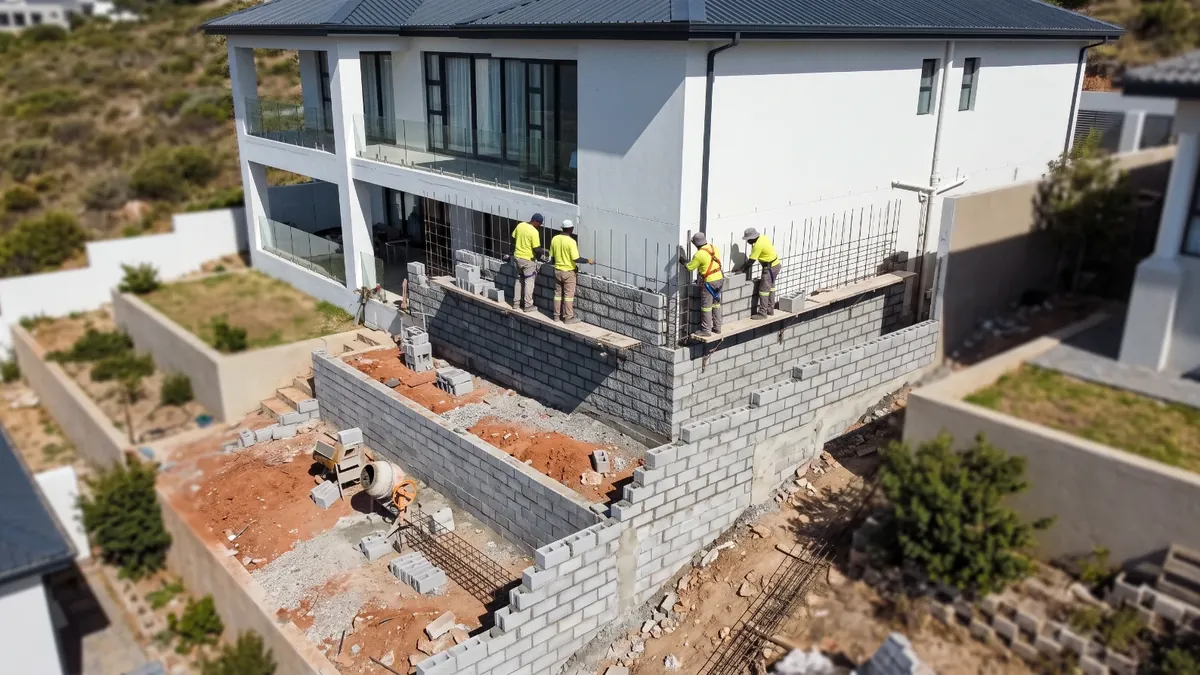
Shotcrete Banks South Africa is sprayed onto a cut face under pressure, so the face is held exactly where it was cut instead of being pulled back to make room for a wall. It is the answer on a stand with no space behind the boundary and on a face too steep to batter. Say how high the face is and whether it is already cut, and compare priced quotations.
Super easy & fast
- Know what a square metre of sprayed face should cost, so you never pay too much.
- Send the same face dimensions to several shotcrete contractors, and quotes come back fast.
- From LEADERR APPROVED providers, vetted and backed by many verified 5-star reviews. Peace of mind that the nails and the mesh match the engineer's drawing.
Say how high the face is and whether it is already cut, and get shotcrete quotes.
Get the Best QuoteShotcrete Banks Prices
Ballpark figures so you can check a quotation.
| Item | Ballpark price |
|---|---|
| Sprayed face, per square metre, unreinforced skin | R1,800 - R2,900 |
| Sprayed face, per square metre, mesh reinforced | R2,400 - R4,500 |
| Soil nails, drilled and grouted, per metre | R650 - R1,700 |
| Welded mesh, supplied and fixed, per square metre | R180 - R420 |
| Face trimming and cleaning, per square metre | R95 - R280 |
| Weep pipes through the skin, each | R220 - R650 |
| Mobilisation of pump and compressor | R9,000 - R32,000 |
| Typical 60 square metre nailed and sprayed face | R175,000 - R390,000 |
Prices JUST UPDATED. Ballpark figures, rounded, excluding VAT. They reflect typical South African retaining wall, repair and slope rates. They are not our prices or quotations, and no provider is bound by them. A retaining wall is quoted on the SQUARE METRES OF ITS OWN FACE, height times length, not on the size of the stand, so confirm what each quotation includes, such as the wall area it is priced on, the excavation, the drainage behind the wall and who removes the spoil.
What a Shotcrete Quote Covers
- Face preparation. Trimming loose material off the cut so the spray lands on sound ground.
- Reinforcement. Welded mesh pinned to the face, or steel fibre mixed into the concrete.
- Soil nails or anchors. Drilled and grouted bars that tie the skin back into the bank behind it.
- The spray itself. Wet or dry mix, built up in layers and priced per square metre of face.
- Weep pipes. Drilled through the skin so water behind it has somewhere to go.
Where Quotes Differ Most
- Wet mix or dry mix. Dry mix suits patchy work and small faces, wet mix suits volume.
- Whether nails are included. A nailed face and an unreinforced skin are two different structures.
- Skin thickness. Set by the design, and it drives the concrete volume directly.
- How the face is finished. Left as sprayed, screeded flat or shaped and coloured to look like rock.
- Access for the pump. The rig has to stand within hose reach of every part of the face.
How the Work Runs on Site
- The cut is trimmed and cleaned. Loose rock and soft pockets come off before anything is sprayed.
- Nails are drilled and grouted. Where the design calls for them, and before the mesh goes on.
- Mesh is fixed to the face. Pinned back so it sits inside the skin rather than against the ground.
- Concrete is sprayed in layers. Built up to the design thickness, with rebound cleared as it falls.
- Weep pipes and the top drain follow. Water taken off above the face and out through it.
Get a price for your own face rather than a range.
Get the Best QuoteWhat Affects the Price
- Face area. Everything is priced per square metre, so height times length is the figure that matters.
- Whether nails are needed. A skin that only stops weathering costs a fraction of one that holds the bank.
- Skin thickness. Set by the design and the single largest swing in concrete volume.
- What the ground is. Rock takes a thinner skin and fewer nails than weathered soil does.
- Access for the rig. Hose reach decides how many setups the job needs.
- The finish you want. A shaped and coloured face is skilled handwork on top of the spray.
- Whether water is running. A seeping face needs drains in before a skin can be sprayed over it.
What to Include in Your Request
- The address. Suburb and town, so a contractor knows whether they work there.
- The face height and length. Measured at the highest point and end to end, even roughly.
- Whether the cut exists yet. An open face and a bank still to be cut are different jobs.
- What stands above it. A boundary, a driveway, a building or open ground.
- Whether water seeps out of it. Wet patches, springs or runoff coming over the top.
- Access. Gate width, standing room and how far the hose has to reach.
Before You Appoint a Shotcrete Contractor
- Ask whether a design covers it. A nailed face is a structure and a professional engineer should have drawn it.
- Ask what the skin thickness is. It should be a number on the quote, not sprayed until it looks right.
- Ask how thickness is checked. Depth pins or probes are normal practice and cost nothing to insist on.
- Ask where the water goes. Weep pipes through the face and a cut-off drain above it.
- Ask about rebound. Material that falls off during spraying has to be cleared, not sprayed over.
- Ask to see a sprayed face they did. Several years old, so you can see how it has weathered and stained.
Shotcrete Banks FAQs
How much does shotcrete cost per square metre in South Africa?
Roughly R1,800 to R2,900 a square metre for an unreinforced skin and R2,400 to R4,500 where mesh is fixed into it. Soil nails are priced separately, commonly R650 to R1,700 a metre drilled and grouted. Mobilisation of the pump and compressor is a fixed charge on top.
Is shotcrete the same as gunite?
They are the same idea with different mixing. Gunite is the dry process, where cement and sand go through the hose dry and water is added at the nozzle. Wet mix shotcrete is batched wet and pumped. Dry mix suits patchy and small work, wet mix suits larger faces.
Does a sprayed face hold the bank up?
Only if it is tied back. A plain skin stops a face weathering and shedding loose material, but it does not resist the ground pushing on it. Soil nails or anchors drilled through the skin into the bank behind are what make it a retaining structure, and that belongs in a design.
Why is shotcrete used instead of a retaining wall?
Because it needs no room. A wall has to be built in front of the bank with a base and backfill behind it, and on a tight stand there is nowhere to put either. Shotcrete holds the face on the line it was cut, which can save a usable metre or two across a whole boundary.
Can a shotcrete face be made to look like rock?
Yes. The skin is shaped, carved and coloured while it is still green, and a good crew can make it read as a natural face. It is handwork on top of the spraying and is priced as such, so ask for it to be a separate line on the quote.
Holding a cut face as cut is what brings most people to Retaining Walls South Africa when there is no room on the stand for a wall at all.
Related Services
Get the Best Quote, Fast
Client Reviews
Powered by leaderr