
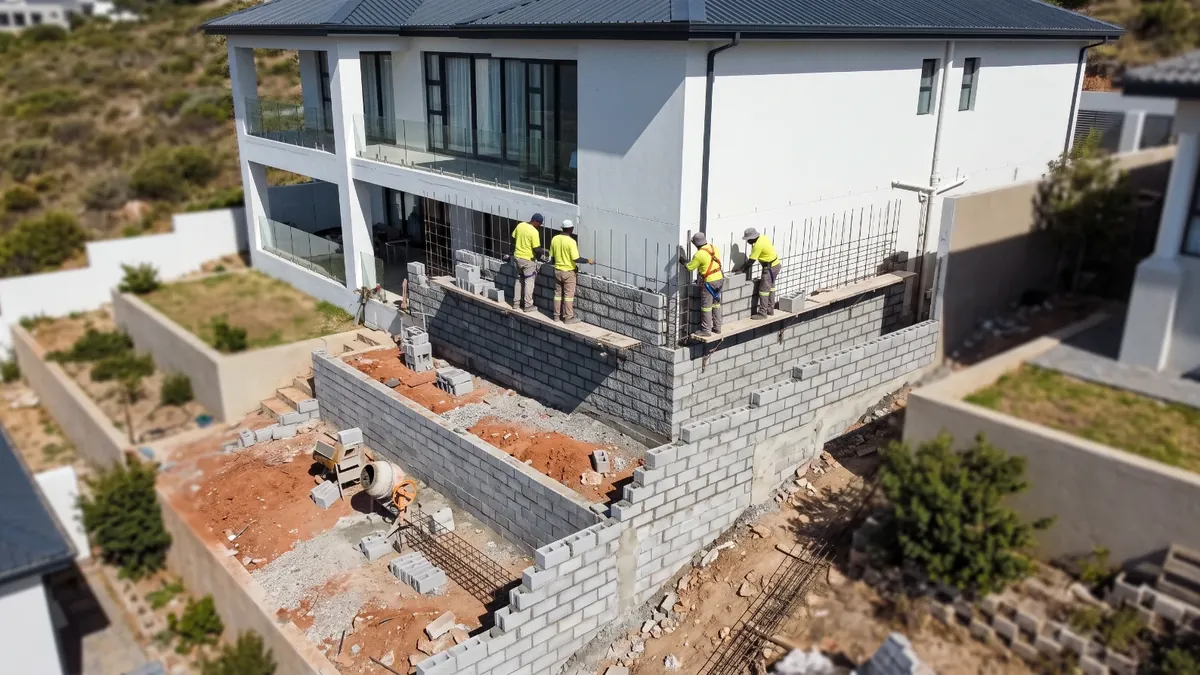
Retaining Wall Builders South Africa are the contractors who cut the bank, lay the drainage and build the wall that holds the ground back. Most quote per square metre of wall face, so the height and the length of the wall matter more than the size of the stand. Say how high and how long, and what is standing above or below it, and get priced quotations to compare.
Super easy & fast
- Know what a square metre of wall face should cost, so you never pay too much.
- Send the same slope details to several wall builders, and quotes come back fast.
- From LEADERR APPROVED providers, vetted and backed by many verified 5-star reviews. Peace of mind that the crew on your site builds to a design and not by eye.
Say how high and how long the wall is, and get building quotes.
Get the Best QuoteRetaining Wall Builders Prices
Ballpark figures so you can check a quotation.
| Item | Ballpark price |
|---|---|
| Dry stack block wall, per square metre of face | R900 - R2,200 |
| Reinforced concrete wall, per square metre of face | R2,500 - R6,500 |
| Gabion wall, per square metre of face | R1,400 - R3,200 |
| Masonry block wall, per square metre of face | R1,200 - R2,800 |
| Bank excavation and trimming, per cubic metre | R120 - R350 |
| Subsoil drainage behind the wall, per metre run | R250 - R700 |
| Spoil removed from site, per load | R1,400 - R3,800 |
| Typical 20 square metre garden wall, built and drained | R26,000 - R58,000 |
Prices JUST UPDATED. Ballpark figures, rounded, excluding VAT. They reflect typical South African retaining wall, repair and slope rates. They are not our prices or quotations, and no provider is bound by them. A retaining wall is quoted on the SQUARE METRES OF ITS OWN FACE, height times length, not on the size of the stand, so confirm what each quotation includes, such as the wall area it is priced on, the excavation, the drainage behind the wall and who removes the spoil.
What a Walling Quote Covers
- Setting out and excavation. Cutting the bank back to a safe batter and trimming the founding line.
- The founding layer. A compacted or concrete base. The wall is only as straight as what it stands on.
- The wall itself. Blocks, concrete, stone or sleepers, priced per square metre of face.
- Drainage behind it. Clean stone, geofabric and a subsoil pipe. The item most often left out.
- Backfill and compaction. Filling behind the wall in layers rather than tipping it in one go.
Where Quotes Differ Most
- Wall height. Height drives the base width, the reinforcement and whether an engineer signs it.
- Which system is priced. Dry stack blocks, cast concrete and gabions are three different totals.
- Whether drainage is in the rate. Some quotes carry the stone and the pipe, some leave them to you.
- Access for plant. A stand a truck cannot reach turns machine work into barrow work.
- What happens to the spoil. Levelled on site, stockpiled or carted away are three different prices.
How the Work Runs on Site
- The bank is cut first. Usually the noisiest day, and the one that needs the most room.
- The base goes in and is checked. Level and line are set here or fought with for the rest of the wall.
- The wall rises in courses. Drainage and backfill come up with it rather than afterwards.
- The top is finished. Capping, a handrail if the drop needs one, and the ground shaped away from it.
- The platform is handed over. Compacted, drained and ready for whatever stands on it.
Get a price for your own slope rather than a range.
Get the Best QuoteWhat Affects the Price
- How high the wall is. Every extra course adds base width, reinforcement and cost per square metre.
- How long it runs. A longer wall spreads the setting out and the plant over more square metres.
- Which system you choose. Material is the single biggest swing between two honest quotes.
- What stands above it. A driveway, a pool or a building above the wall changes the design load.
- Ground conditions. Rock means breaking, clay means a wider base and more drainage.
- Access. Gate width and ground firmness decide whether a machine or a wheelbarrow does the work.
- Whether a design is needed. An engineer's drawing and sign-off is a separate professional fee.
What to Include in Your Request
- The address. Suburb and town, so a contractor knows whether they work there.
- The height and length. Measured at the highest point and end to end, even roughly.
- What is above and below. A house, a driveway, a pool, a boundary or open garden.
- What the ground is. Rock, clay, sand or fill, and anything you know about the slope's history.
- Access. Gate width, ground conditions and how close a truck can get.
- Your timing. Council approval and an engineer's design take time before a crew can book.
Before You Appoint a Wall Builder
- Ask what the wall is designed to hold. Soil alone, or soil plus a driveway or structure above it.
- Ask who signs the design. Over about 1.5m most municipalities want a registered engineer's drawing.
- Ask what the drainage is. Stone type, geofabric and where the water comes out, in writing.
- Ask to see two walls they built. Three or four years old, so you see what has moved and what has not.
- Ask about the guarantee. What it covers, how long it runs and whether drainage is excluded from it.
- Ask what is not in the price. Spoil removal, capping, handrails and reinstating the garden are the usual ones.
Retaining Wall Builders FAQs
How much does it cost to build a retaining wall in South Africa?
Measured per square metre of wall face, roughly R900 to R2,200 for a dry stack block wall and R2,500 to R6,500 for a reinforced concrete one. A 20 square metre garden wall, built and drained, commonly lands between R26,000 and R58,000. Height, access and drainage move it more than anything else.
Do I need council approval for a retaining wall?
Usually above about 1.5m, and often sooner if the wall is near a boundary or holds a driveway or structure. The threshold is set by your own municipality, so check with yours before work starts. Below that, many garden terraces are built without plans.
How long does a retaining wall take to build?
A small garden wall is often a week on site. A 2m platform wall with drainage and backfill is commonly two to four weeks. The design and approval before it, where one is needed, usually takes longer than the building.
Which retaining wall is cheapest?
Treated timber sleepers for low garden steps, and dry stack concrete blocks for anything that has to last. Cast concrete is the most expensive per square metre but takes the most load, so cheapest and suitable are not always the same answer.
Can a retaining wall be built against a boundary wall?
It should not lean on one. A boundary wall is not designed to hold ground, and loading it is how both walls end up failing. The retaining structure is built as its own wall, with its own base and drainage, clear of the boundary.
Building the wall is the service nearly every contractor on Retaining Walls South Africa is asked for first, and the one most worth lining up quotations on.
Related Services
Get the Best Quote, Fast
Client Reviews
Powered by leaderr